The U.S. Aluminum Industry is the world’s largest, producing about 20 billion pounds of metal annually. The industry employed 141,000 people with an annual payroll of $5.2 billion and shipped $38.8 billion in products in 2000. The high quality of these products and the profitability of the industry are due, in large part, to the contributions of a niche industry made up of the Master Alloys and Additives companies. These companies have dedicated their efforts to providing the Aluminum Industry with special alloys and additives that reduce manufacturing cycle time and enhance product quality. Some of their contributions to the aluminum industry are presented below.
http://www.aluminum.org/Content/NavigationMenu/TheIndustry/MasterAlloys/default.htm
Saturday, July 26, 2008
ALUMINUM MASTER ALLOYS AND ADDITIVES “THE MAGIC INGREDIENTS”
Wednesday, March 12, 2008
Yamaha to introduce DiASil cylinder in India

According to Mr. Sanjay Tripathi, Head of Dept- Product Planning & Strategy, “Conventional engine cylinders have a steel liner to reduce the friction resulting from the piston's movement. The "DiASil" cylinder is made by the exclusive Yamaha Aluminum Controlled Forging (CF) technology. Because the "DiASil" Cylinder is all aluminum, it has excellent heat dissipation qualities and reduces engine weight at the same time. In comparison to cast steel liner type aluminum cylinders, the DiASil cylinder has 60% better cooling performance at 30% lower manufacturing cost and enables 30% lighter design which results in better power to weight ratio besides excellent recyclability”.
“Considering the environment-friendly nature of aluminum, we have made aluminum technologies part of our core technology and actively increasing the use of aluminum in our products. Our CF Aluminum Die-cast Technology enables the mass production of die-cast aluminum parts that are both thinner and larger than was possible in the past. This same technology has been applied to the manufacture of engine parts. This is also a technology that can be easily transferred to overseas Yamaha manufacturing bases. Yamaha also plans to apply to new areas automobile and outboard motor engine parts”, he added.
This next-generation technology promises to contribute to improved function and product quality for the majority of Asian market motorcycles and automobiles that presently use conventional pistons with cast steel liners.
Sourced From: Mavcomm Consulting Pvt Ltd
Monday, February 11, 2008
Effect of alloying elements (Silicon)
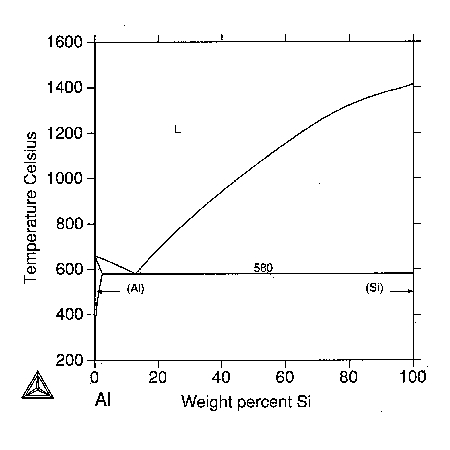
The eutectic alloys have the highest fluidity for a given casting temperature and having a short freezing range, they solidify with primary shrinkage. They are good for thin section castings. Where higher strength is needed, the lower silicon alloys are used. The hypereutectic alloys are difficult to machine, they are used for wear-resistant applications such as pistons. To better refine primary silicon in hypereutectic alloys, P is often used.
Sunday, February 3, 2008
Grain refinement of aluminum casting alloys
Website Only Article: Grain Refinement of Aluminum Casting Alloys
G. Sigworth
Alcoa Primary Metals, Rockdale, Texas
and T. Kuhn
Alcoa Primary Metals, Frederick, Maryland
The mechanisms and benefits of grain refinement are described. Downloadable from AFS site
Abstract
An overview is given of grain refinement in aluminum casting alloys. The mechanisms involved and the benefits ofrefinement are described. The review shows that current practices were developed long before modern Al-Ti-B refinersbecame available, and are employed now largely for historical reasons. The results of tests in Al-Si, Al-Si-Cu, Al-Cu, Al-Mgand Al-Zn-Mg alloys are presented. The grain refining response is different for each alloy system. It is important tounderstand that titanium can be present in two forms. One dissolves in aluminum; the other is nearly insoluble. Each must becontrolled separately. With today's powerful Al-Ti-B refiners, there is no reason for large additions of soluble titanium inmost alloys. In fact, it is better to say we grain refine with boron, not titanium. The recommended addition is 10-20 ppm ofboron, preferably in the form of Al-5Ti-1B or Al-3Ti-1B rod. Lower dissolved titanium levels provide better grainrefinement and an improved resistance to hot cracking in some alloys. Al-Si casting alloys which contain copper are anexception. In alloys such as 319 or 355, it is best to have a minimum of about 0.1 % Ti.
Monday, January 21, 2008
Aluminum alloy for producing high performance shaped castings

- Patent number: 7087125
- Filing date: Jan 28, 2005
- Issue date: Aug 8, 2006
- Inventors: Jen C. Lin, Cagatay Yanar, Wenping Zhang, Pål S. Jacobsen, Geir Grasmo, Michael K. Brandt, Moustapha Mbaye, Martijn Vos, Michael V. Glazoff, Knut Pettesen, Svein Jorgensen, Terje Johnsen
- Assignee: Alcoa Inc.
- Primary Examiner: George Wyszomierski
- Secondary Examiner: Janelle Morillo
- Attorneys: Greenberg Traurig LLP, Harry A. Hild, Jr.Application number: 11/045,845
Saturday, January 5, 2008
Effect of casting imperfections on the fatigue life of 319-F and A356-T6 Al–Si casting alloys
 Effect of casting imperfections on the fatigue life of 319-F and A356-T6 Al–Si casting alloys
H.R. Ammara, A.M. Samuela and F.H. Samuel, a, aDépartement des Sciences Appliquées, Université du Québec à Chicoutimi, 555 Boulevard de l’Université, Chicoutimi, Québec G7H 2B1, Canada
Abstract
Casting imperfections, such as porosity, in cast aluminum components greatly influence their fatigue properties. The effect of porosity on the fatigue life of 319-F and A356-T6 aluminum alloys was studied, where the porosity characteristics on the fracture surfaces of fatigue-tested samples were examined using SEM and image analysis. The results show that porosity has the greatest detrimental effect on fatigue life: 92% of all tested samples fractured as a result of porosity which acted as the main crack initiation site. In the absence of casting imperfections, other microstructural aspects such as slip bands may be held responsible (4%). Porosity was investigated in terms of the pore size at the sample fracture surface. It was found that fatigue life decreases as the size of the surface pore increases. A comparison was made between the fatigue behavior of low-pressure-permanent mold-cast 319 alloy and lost foam-cast A356-T6 alloy. The results show that the 319 alloy provides greater fatigue strength compared to the 356 alloy, which may be explained by taking into consideration the nature of the surface porosity (single pore versus multiple shrinkage pores) that initiated the fatigue crack in the two alloys. The microstructural characteristics are of secondary importance in this regard.
doi:10.1016/j.msea.2007.03.112
